

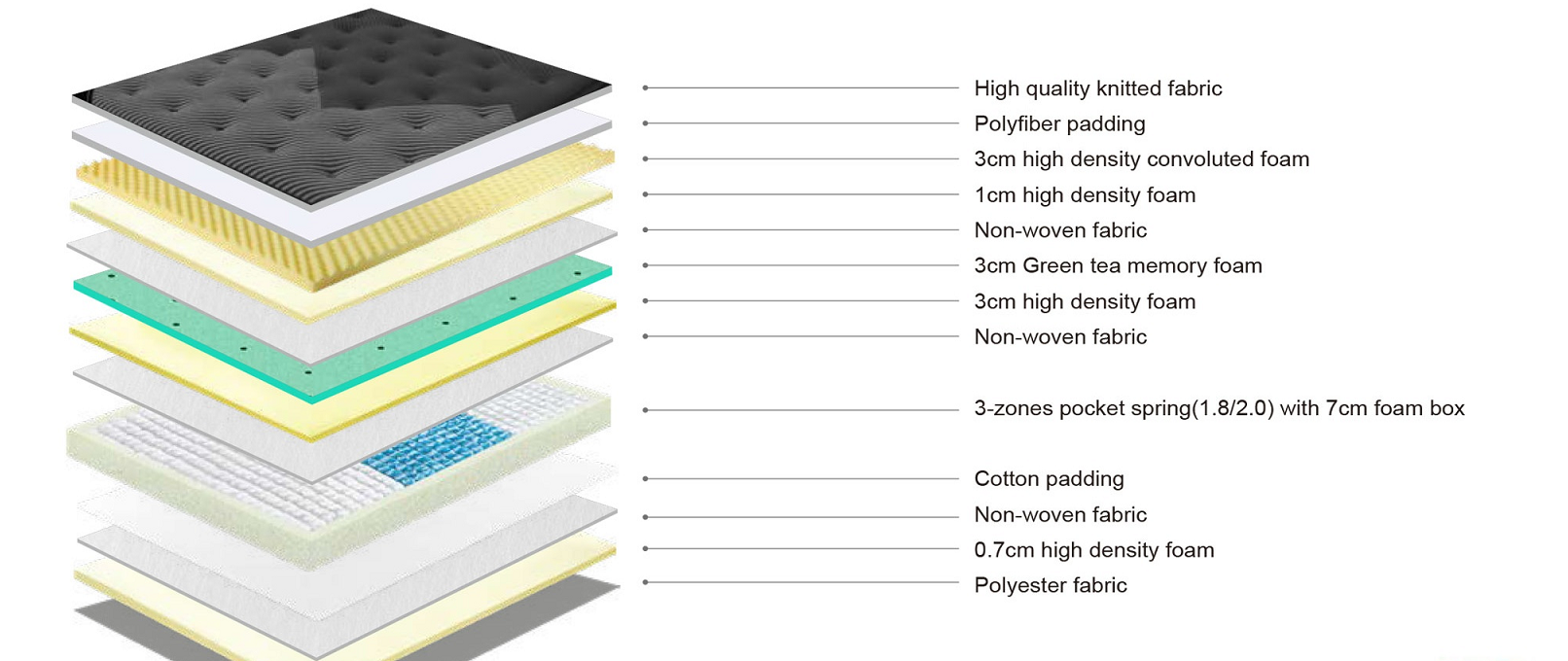
A soft surface can feel appealing in a showroom and still fail to explain how a mattress will behave after months of use. Comfort begins where the body meets the cover, but support and durability depend on what lies below it. Each layer changes the load carried by the next, as well as the heat, movement, and wear experienced at the surface. Understanding those interactions gives a more useful basis for comparing mattresses than a single material name.
Material quality matters, yet placement matters too. A resilient layer cannot correct an unsuitable core, and a strong spring unit can feel harsh without cushioning. The complete construction must manage pressure and retain its shape.
Start at the Sleeping Surface
The cover and upper padding determine the first sensation of contact. Fabric weave influences airflow and how quickly moisture can move away from the sleeper. Padding affects the transition from fabric to the firmer layers underneath. Layers beneath the cover may still restrict air movement. Surface comfort is therefore a property of the upper assembly, not the cover alone.
Polyfiber padding can add a light, cushioned feel without being the primary support structure. Foam underneath changes how quickly the surface yields and recovers. A slow-rebound material contours to the body over a longer interval, while a more resilient layer responds faster to movement. Contouring and quick repositioning serve different sleep preferences. The thickness and position of each layer determine whether a desired feel remains stable once the body settles.
Mattress material types also age in different ways. Mattress materials at the surface face compression, friction, and moisture; deeper layers carry load for longer periods. A material that feels comfortable at first may lose that effect if the construction beneath it allows excessive sinking. Durability has to be judged across the complete layer stack rather than inferred from the softness of a hand-pressed sample.
Follow Pressure Through the Comfort Layers
Pressure distribution depends on both contouring and support. Foam can spread contact over a larger area, reducing concentrated pressure at shoulders or hips. Too much initial give, however, can let heavier areas sink without enough resistance. Multiple foam gauges and layer thicknesses are used to control that transition. A mattress materials comparison should ask where the comfort layer ends and how the support below it responds.
A documented layer stack from Suisin Furniture combines knitted fabric, polyfiber padding, several gauges of high-density foam, slow-rebound memory foam, convoluted wave foam, and pocketed springs. The company attributes airflow channels and surface-pressure distribution to convoluted foam, while slow-rebound memory foam is described as contouring around body curves and absorbing movement. These are material functions, not a guarantee that every combination will produce the same feel. Thickness, layer arrangement, and the sleeper’s load matter.
Motion isolation illustrates the interaction. A foam layer may absorb some movement near the surface, while individually pocketed springs can respond more locally than a tightly linked spring system. The result also depends on the cover, the number and layout of springs, and the amount of foam between the sleeper and the core. A comparison examines the assembled mattress rather than assigning the whole outcome to one layer.
Examine the Core and Its Protected Edges
The support core carries much of the sustained load. Pocketed springs provide a structure that can be arranged in zones, allowing different areas to respond to shoulders, lumbar region, and hips. The principle is to vary resistance where body weight and shape differ. A zoned label alone does not establish whether the resulting support suits a particular sleeper; spring design and the surrounding layers determine the actual response.
Edges face a separate stress. Sitting near the side and entering or leaving the bed concentrate force over a smaller area. Reinforcement helps keep the usable surface stable and protects the perimeter from early collapse. Suisin Furniture’s materials information describes reinforced edge support and thermobonded hard cotton used for rigid support and to protect upper layers from the spring unit. That protective layer can matter for wear even though the sleeper may never feel it directly.
The page also describes foam with CertiPUR-US and OEKO-TEX-related safety credentials. Such statements are relevant when evaluating materials, but the exact component and applicable documentation still need to be checked for the mattress being purchased. A credential attached to one foam should not be silently treated as certification of every layer or of the finished product.
Judge the Construction, Not a Single Ingredient
Different mattress material types link comfort and durability through the load path. Fabric and padding affect surface feel; comfort foam spreads pressure; the core controls deeper support; protective and edge layers help preserve the structure. Changing one component can shift the balance among those functions. A thicker plush layer, for example, may alter both immediate comfort and the stress that mattress materials transfer to the core.
A material comparison therefore records the layer order, key dimensions, intended use, and the evidence available from a sample or specification. The answer to how materials affect a mattress lies in their combined response under repeated use, from first contact to the support that remains years later.


