

Investing in advanced metrology tools represents a major milestone for any developing workshop or fabrication facility. Balancing tight production budgets against the demanding requirements of modern quality control is a constant challenge. Deciding whether to adopt a handheld 3D scanner involves evaluating how modern dimensional verification impacts long-term business growth.
Every manufacturing decision requires a clear calculation of speed, accuracy, and overall equipment versatility. For smaller operations, traditional stationary coordinate measuring machines often present steep space and environmental requirements. Modern portable optical measurement devices offer alternative pathways to achieve industrial-grade quality control without excessive overhead.
Understanding the Operational Needs of Small Scale Shops
Small shops typically operate under unique constraints, including limited physical workspace, changing production lines, and variable temperature conditions. Traditional coordinate measuring machines require highly stable, climate-controlled inspection rooms to deliver reliable data. This environmental dependency makes them challenging to integrate into compact, dynamic shop layouts.
Conversely, a handheld 3D scanner operates reliably in diverse environments, allowing for direct part measurement on the production floor. Eliminating the need for a dedicated, air-conditioned metrology lab saves valuable floor space and reduces initial infrastructure setup costs. This environmental adaptability is particularly valuable for facilities handling diverse, low-volume production runs.
Evaluating Speed and Workflow Efficiency Gains
Time remains a critical currency for any growing manufacturing business seeking to maximize daily output. Employing a handheld 3D scanner allows operators to capture complete surface geometries in a fraction of the time required by manual methods. This rapid data acquisition helps identify manufacturing defects early, preventing wasted machining time on out-of-tolerance parts.
Shorter inspection times translate directly into faster turnaround cycles and improved delivery times for clients. While mechanical caliper measurements only provide discrete dimensions, optical scanning captures complete surface profiles instantly. This comprehensive digital feedback speeds up first-article inspections and accelerates complex reverse engineering projects.
Assessing the True Costs of Optical Metrology
The initial price tag of high-resolution scanning equipment can seem daunting to budget-conscious business owners. However, a complete financial assessment must include training times, labor hours, and potential reduction in material waste. A user-friendly handheld 3D scanner requires less specialized training to operate compared to complex, program-heavy stationary installations.
Furthermore, minimizing part rejection rates and material scrap helps smaller operations recoup their initial technology investments quickly. Accurate digital tracking also reduces human error during manual measurements, protecting the workshop from costly warranty claims. Analyzing these long-term operational savings often reveals that portable optical systems provide an excellent return on investment.
Exploring Versatility Across Diverse Applications
A key advantage of modern optical systems is their ability to handle highly diverse manufacturing jobs. Whether a workshop is verifying cast iron molds, plastic injection parts, or welded frames, non-contact scanning adapts easily. This flexibility allows a single device to serve multiple business areas, from quality assurance to product design.
Additionally, non-contact measurement prevents the deformation of delicate or flexible materials during the inspection process. Because the light-based sensor never physically touches the workpiece, sensitive surfaces are completely protected from scratches or pressure. This versatility opens up new business opportunities, enabling small shops to confidently bid on complex aerospace or medical projects.
Finding a Balanced Solution with Hybrid Systems
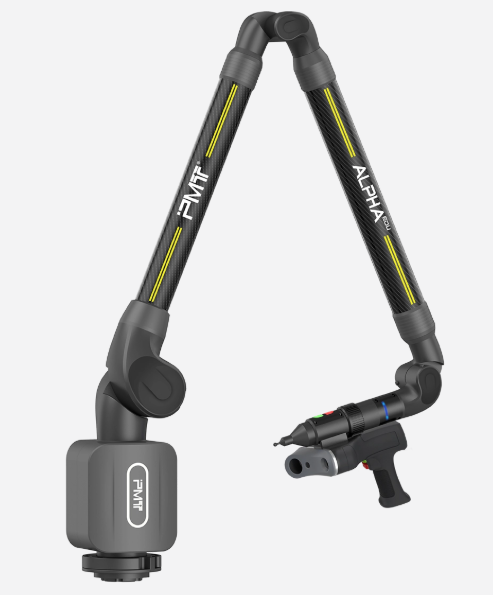
For facilities requiring both contact probing and scanning capabilities, hybrid systems offer a highly practical alternative. The PMT ALPHA portable measuring arm provides an integrated, versatile 6/7-axis configuration designed specifically for flexible, on-site industrial measurements. This system easily transitions between tactile probing and high-speed laser scanning to handle diverse quality control challenges.
By offering multiple measurement configurations in a single portable setup, this hybrid approach delivers dual functionality. Operators can use tactile probes for tight geometric tolerances and then quickly switch to laser scanning for complex surface profiles. Choosing adaptable equipment from PMT ensures that a workshop remains prepared for changing client requirements.
Enhancing Training and Educational Integration
Implementing new quality control technologies also requires considering the learning curve of the existing workforce. The intuitive nature of modern 3D visualization software simplifies the operator training process compared to older coordinate metrology platforms. This simplicity allows general technicians to perform accurate, repeatable scans without needing a dedicated metrology degree.
In addition to industrial workshops, these portable systems are highly suited for technical education and vocational training programs. Introducing flexible tools like the PMT ALPHA arm to student workrooms helps future technicians develop valuable real-world measurement skills. Broadening the reach of advanced metrology ensures that both current and future operators can utilize these tools effectively.
Conclusion
Determining if a handheld 3D scanner is worth the investment requires analyzing specific production bottlenecks and growth goals. While traditional systems remain vital for specific sub-micron tasks, portable optical systems offer the flexibility and speed that modern workshops need. Adopting versatile, multi-axis hardware from PMT allows small businesses to maximize their inspection capabilities, ensuring long-term competitiveness in a demanding market.


